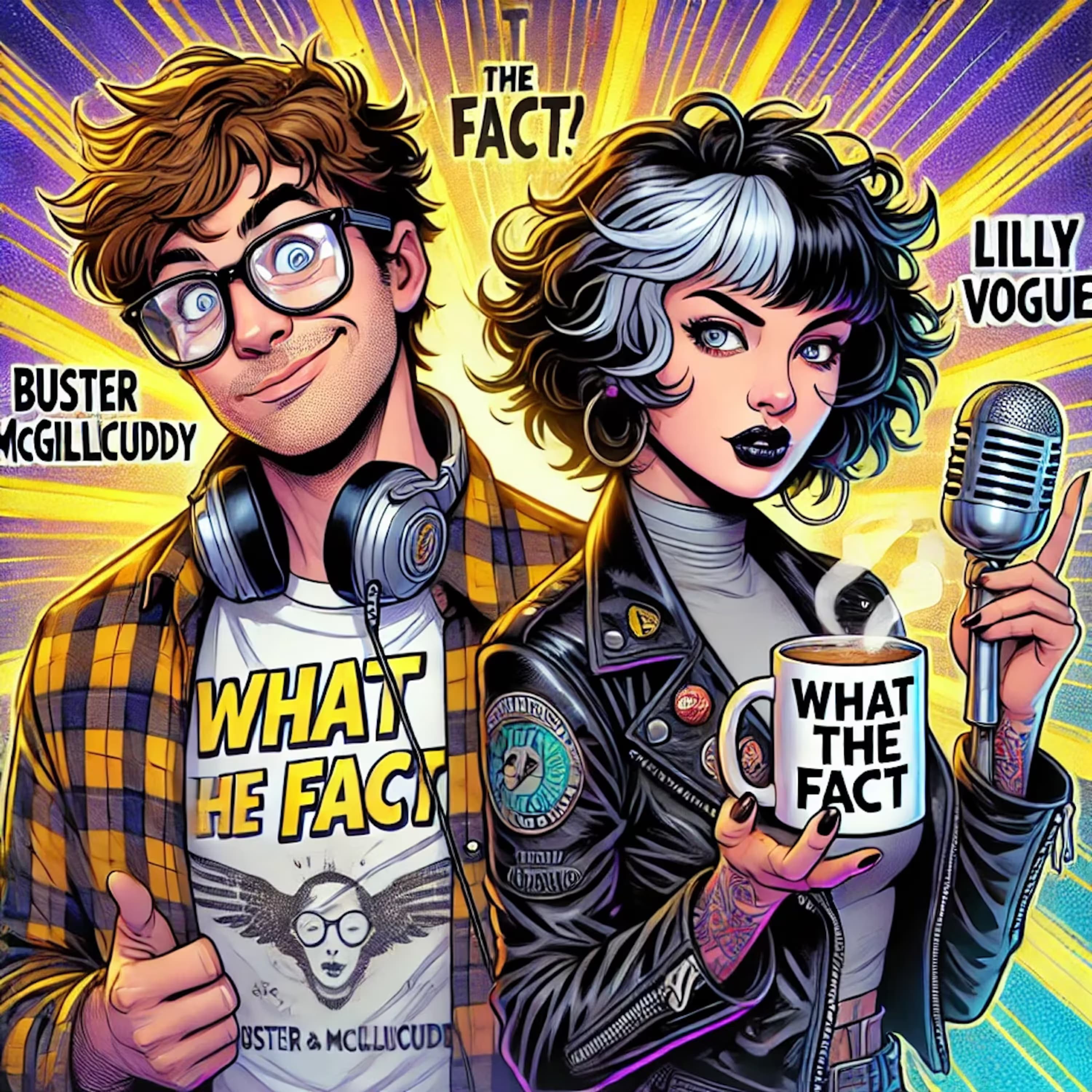
EPISODE 5 - History's Famous Hoaxes and Why They Fooled Us
This show was created with Jellypod, the AI Podcast Studio. Create your own podcast with Jellypod today.
Get StartedIs this your podcast and want to remove this banner? Click here.
Chapter 1
This is Episode 5
Lily Vogue
Hello, wonderful listeners, and welcome back! You’re tuning in to Episode 5 of our enchanting, mysterious, and often laughably absurd exploration into history’s greatest hoaxes and the enduring gullibility of humankind.
Buster McGillicuddy
Episode 5, huh? That's like a milestone... kinda. And we’ve got a fresh batch of trickery served up for y’all today.
Lily Vogue
Before we dive into today’s juicy tales, a special shoutout to our sponsor, the AI Salon. They’re redefining creativity and collaboration in the digital space. Whether it’s refining your podcast script—
Buster McGillicuddy
Or figuring out how to not get duped by an email scam!
Lily Vogue
Exactly. AI Salon has you covered. Check them out at thesalon.ai.
Buster McGillicuddy
That’s “thesalon” dot “ai.” Like artificial intelligence. See what I did there?
Lily Vogue
Very clever, Buster. Now on to the good stuff...
Buster McGillicuddy
Yeah, why people fall for the most ridiculous hoaxes. Can’t wait to laugh at people from history—
Lily Vogue
Or yourself, perhaps?
Buster McGillicuddy
Hey now, let’s not bring up that Nigerian prince thing again.
Lily Vogue
Oh, we certainly will. But today...
Chapter 2
Fool Me Once: Iconic Hoaxes That Fooled the World
Lily Vogue
Speaking of gullibility, let’s dive right into one of the greatest—and most audacious—hoaxes of all time: the Piltdown Man. Buster, ever fallen for anything this big?
Buster McGillicuddy
Ah yes, the missing link. Or as I like to call it, “the monkey business that wasn’t.”
Lily Vogue
Exactly. Discovered in 1912 in England, this so-called fossil was hailed as proof of the evolution from apes to humans. It took decades for scientists to figure out they’d been duped. It wasn’t a transitional fossil—it was essentially a chimpanzee jaw fused with a human skull.
Buster McGillicuddy
And no one thought, “Hey, this looks like something a middle schooler glued together in art class?”
Lily Vogue
Apparently not! Even esteemed scientists of the time were convinced. It was only in the 1950s that modern dating techniques exposed it as a complete fabrication. The fallout was massive—it dented the reputation of British anthropology for years.
Buster McGillicuddy
I can just imagine the guy behind it, snickering like, “Wait, they’re still buying it?!”
Lily Vogue
Exactly. Now let’s talk about hoaxes of a more...journalistic persuasion. Take Jayson Blair and Janet Cooke, two reporters from The New York Times and The Washington Post, respectively.
Buster McGillicuddy
Ooh, fabricated stories? Sounds like the gossip column from my hometown paper.
Lily Vogue
Sadly, these tales weren’t confined to small-town rumor mills. Blair was caught fabricating quotes, locations, even entire events in his articles. And Cooke? She concocted a Pulitzer-winning story about an eight-year-old heroin addict—a sad, gripping story that turned out to be completely fictitious.
Buster McGillicuddy
Man, even fiction writers don’t have that kind of nerve.
Lily Vogue
It really rocked the credibility of major news outlets at the time. Readers didn’t know whom to trust anymore. I mean, if the ‘paper of record’ can’t get it right...
Buster McGillicuddy
...then my uncle’s weekly alien sightings don’t sound too bad, huh?
Lily Vogue
Exactly my point. Lastly, let’s travel back to 1835 for one of the first viral hoaxes: The Great Moon Hoax. This one’s a real gem.
Buster McGillicuddy
Please tell me it involves aliens.
Lily Vogue
Almost. Back then, a newspaper claimed a famous astronomer had discovered life on the moon—bizarre plants, animals, even creatures that looked like flying humans. The public went mad for it. People believed it wholeheartedly!
Buster McGillicuddy
Wait, flying humans? Did they throw in free moon cheese with this story?
Lily Vogue
It does sound absolutely absurd now. But back then, newspapers didn’t have the kind of fact-checking processes they *claim* to have today. It just goes to show how easily even smart people can be fooled when they want to believe in something extraordinary.
Buster McGillicuddy
So...moral of the story: if it sounds too good to be true, it probably is. Unless moon cheese is involved. That, I might consider.
Lily Vogue
Of course you would, Buster.
Chapter 3
Gullibility Cultures: Why People Believe Hoaxes
Lily Vogue
Alright, Buster, let’s dig into why even the sharpest tools in the shed—like our charming listeners—can get taken for a ride so easily.
Buster McGillicuddy
Yeah, because heaven knows it’s not us. We’re too sharp for that... right?
Lily Vogue
Of course, Buster. But it all starts with the psychology of belief — one of the key culprits being something called the bandwagon effect. Essentially, when a large group of people believe in something, others tend to follow, assuming there must be some truth to it.
Buster McGillicuddy
Like how everyone suddenly loves kale. One person says it’s a superfood, and bam! Next thing you know, it’s in everything from smoothies to ice cream. Speakin’ of scams...
Lily Vogue
Exactly. And this effect is amplified in today’s information-saturated world, where ideas spread like wildfire. Take the urban legend of the Pacific Northwest tree octopus. Someone posted a spoof webpage, claiming an octopus species lived in forests and used tree branches like tentacles. It was utterly absurd, but plenty of people fell for it.
Buster McGillicuddy
Ha! Reminds me of that time I convinced my coworkers we had "cactus armadillos" back home in Texas. Said they curled right up under mesquite trees to shade themselves. They totally bought it... for a week.
Lily Vogue
Buster, I’m not sure whether to be impressed or concerned. But it highlights a key point: add a dash of plausibility and our minds fill in the rest. Even we’re not immune. Now, let’s examine public hoaxes and their wider impact. Remember the Balloon Boy incident in 2009?
Buster McGillicuddy
Oh yeah — folks thought a kid was cruisin’ across the sky in a homemade helium spaceship. Turns out he was, uh... grounded. In his family’s attic the whole time!
Lily Vogue
Exactly. It was a media frenzy, but it turned out to be a stunt orchestrated by the parents for fame. And yet, millions of people believed it because the story fit into a sensational, ready-to-go narrative. The same thing happens with fake death rumors about celebrities. Social media spreads them faster than traditional fact-checking can keep up. It’s... fascinating and terrifying all at once.
Buster McGillicuddy
Kinda like how my aunt’s pie recipes spread through the town Facebook group. One person makes it wrong, everyone else copies them, and next thing you know, there’s a five-person feud over burnt crusts.
Lily Vogue
Only slightly less consequential than hoaxes, I’m sure. But it all circles back to how our craving for novelty and sensationalism blinds us to reality.
Buster McGillicuddy
So basically, humans are wired to believe first, question second. Especially when there’s a tree octopus involved.
Lily Vogue
Precisely.
Chapter 4
Hoaxes That Bite Back: When Tall Tales Turn Harmful
Lily Vogue
So if we’re wired to believe first and question later, it’s no surprise hoaxes can range from harmless fun to dangerous deception. Take something like the Pacific Northwest tree octopus—ridiculous and good for a laugh. But when a hoax turns into fraud, like the Sokal Affair, or fear-mongering, like the Momo Challenge, the stakes rise considerably.
Buster McGillicuddy
Right, one minute you're chucklin’ at an imaginary octopus, and the next, you’re freakin’ out over some viral nonsense. People love a good scare, don’t they? I mean, as long as it’s happening to someone else, of course.
Lily Vogue
Exactly. The Momo Challenge is one of those hoaxes that weaponized fear. Although it was debunked as a baseless internet myth, it sparked real panic among parents and communities worldwide. It shows how easily an idea can spiral out of control once it hits the right nerves.
Buster McGillicuddy
Yeah, like that time I almost fell for one of those “your account’s been hacked” phishing scams. I swear, Lily, they made the email look so real. There I was, about to wire money to “tech support,” when my wife walks in and goes, “Buster, were you actually about to send cash to Captain Obvious at scammer.net?”
Lily Vogue
Oh, dear. Buster, even you?
Buster McGillicuddy
What can I say? The email promised “urgent action required,” and I—well—I panicked! Shows that hey, no one is completely scam-proof.
Lily Vogue
You’re absolutely right. No matter how intelligent or skeptical we think we are, there’s always a crack in the armor. That’s what so many successful hoaxes depend on. They exploit our instincts—be it fear, trust, or the lure of something too good to be true.
Buster McGillicuddy
Or just plain curiosity. Like, c’mon, who wouldn’t wanna know about some legendary tree-octopus or a Nigerian prince in dire need of your bank account?
Lily Vogue
Indeed. But distinguishing between innocent fun and harmful deceit is the real challenge, isn’t it? And it’s our responsibility to hit the pause button and question—“Does this make sense?”
Buster McGillicuddy
Good advice. So before y’all click on that too-good-to-be-true link, remember: if your gut says “scam,” it probably is. Oh, and don’t wire money to Captain Obvious.
Lily Vogue
Wise words, Buster. On that note, wonderful listeners, we’ll leave you with this: as long as there are people, there will be hoaxes, and as long as there are hoaxes, there will be lessons to learn—and laugh about.
Buster McGillicuddy
And remember, folks, stay curious, but don’t let curiosity zap your common sense. Until next time, keep those wits about you!
Lily Vogue
Goodbye for now!