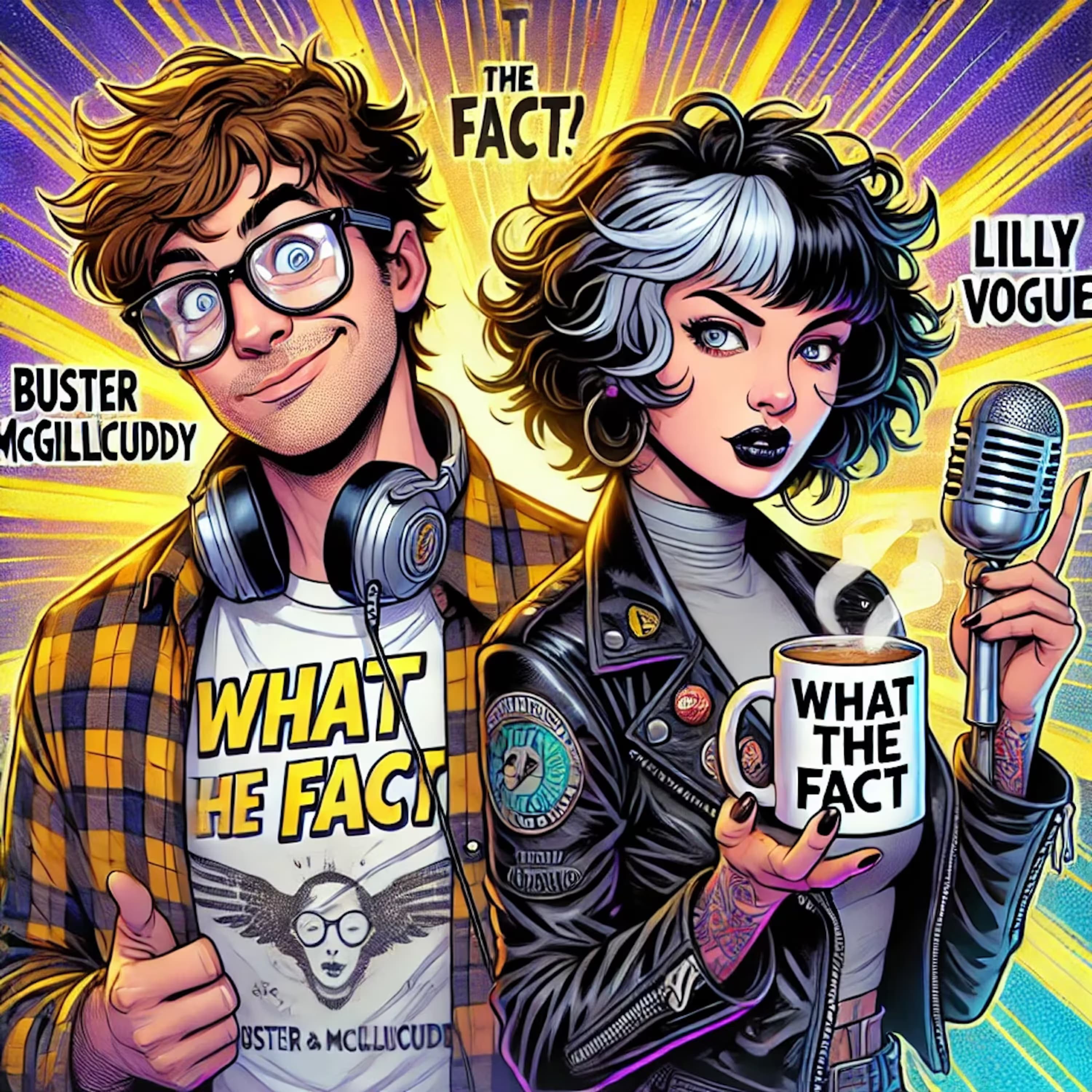
Episode 18 - Animal Trials in Medieval Europe
In this episode, Lily and Buster recount the strange history of medieval animal trials, including a pig charged with murder and a virtuous donkey's surprising acquittal. While humorously discussing bizarre cases like caterpillars condemned for crop destruction, they examine the deeper cultural and legal implications of these events. Listen as they bring historical transcripts and peculiar anecdotes to life, revealing humanity's odd drive to assign blame—even to animals.
This show was created with Jellypod, the AI Podcast Studio. Create your own podcast with Jellypod today.
Get StartedIs this your podcast and want to remove this banner? Click here.
Chapter 1
Introduction
Lily Vogue
Welcome to "What the Fact?!"—the podcast that dives into the strangest bits of history, science, and all-around absurd trivia. Today’s episode is number eighteen—can you believe it?
Buster McGillicuddy
Eighteen. Wow. That’s almost...like, a whole adult podcast now.
Lily Vogue
Exactly! We’ve grown so much. And today, we’re diving into an absolutely wild topic that’ll have you questioning everything you thought you knew.
Buster McGillicuddy
Yeah, when Lily says "wild," there’s usually a courtroom and something ridiculous involved. And, folks, today’s no exception.
Lily Vogue
But, before we plunge into the madness that is medieval judicial practices, we have to thank our sponsor for making this episode possible: the AI Salon. It’s theSalon dot A-I. Have you ever wondered what you’d look like as a Renaissance painting?
Buster McGillicuddy
Or maybe, a cyborg cowboy? Because that’s what I’d want.
Lily Vogue
Naturally. Well, the AI Salon lets you turn your selfies into stunning digital art in just seconds. It’s easy, and the results are shockingly good. It’s tasteful and, obviously, a lot of fun. So check them out at theSalon dot A-I.
Buster McGillicuddy
Seriously, give it a shot. And, hey, thanks to them for keeping us in business because these microphones don’t pay for themselves.
Lily Vogue
Alright, let’s get to it. I promise, you won’t believe what people used to think was, uh, reasonable behavior back in the Middle Ages.
Buster McGillicuddy
Oh, I’m ready. If there’s a pig on trial or Satanic chickens, I’m all in.
Lily Vogue
Oh, there will be. Stick around. You don’t want to miss this one.
Chapter 2
The Curious Case of Animal Trials
Lily Vogue
Okay, get this: It’s the 13th century, a dimly lit courtroom buzzing with anxious whispers. Villagers crowd the space, and then—wait for it—the accused is brought forward. It’s not a man, not a noble... but a pig. Yes, an actual pig stands trial for murder. You can’t make this stuff up.
Buster McGillicuddy
Wait, a pig? Like, a literal pig?
Lily Vogue
Oh, yes. A pig. And not just that, this pig actually had legal representation. A defense lawyer, sitting there, presumably taking this very seriously.
Buster McGillicuddy
Hold on. Did the pig get to pick its lawyer? Or, like, was there a medieval pig public defender assigned?
Lily Vogue
Well, I can’t say for sure how they handled, uh, pig-client privilege, but yes, this actually happened. Courts assigned lawyers to animals accused of crimes. Let that sink in.
Buster McGillicuddy
It’s sinking, alright... but it’s mostly sinking into, like, a puddle of disbelief. What crimes are we talking about here? Did this pig run some kind of medieval Ponzi scheme?
Lily Vogue
Not quite. Most of these cases were homicide. And for the record, this wasn’t just a quirky one-off thing. We’re talking centuries of documented animal trials all across Europe. Pigs, rats, even caterpillars dragged into court—
Buster McGillicuddy
Caterpillars?
Lily Vogue
Oh, we’ll get to them. But first, back to the pigs. These were treated just like human defendants. They were tried in secular or ecclesiastical courts, witnesses were called, and if convicted—
Buster McGillicuddy
Wait. They called witnesses? Like, "I saw the pig at the scene of the crime—I swear it was him"?
Lily Vogue
Exactly! And for the ecclesiastical cases, where the church was involved, animals even had full legal counsel. Let me read you an excerpt from one of these bizarre trial records.
Buster McGillicuddy
Oh, here we go. Is this where it gets completely bananas?
Lily Vogue
Here’s the gist: "The accused, a female donkey, stood charged with an ‘unnatural crime.’ But, good news for her, the court determined that witness testimony defending her character was overwhelming. The donkey was, and I quote, ‘in all her habits of life a most honest creature.’”
Buster McGillicuddy
Wow. So, not only did this donkey dodge the sentence, but she also got a glowing Yelp review from the entire village.
Lily Vogue
Pretty much. And this wasn’t even the wildest case. The way these trials intertwined religious morality and the emerging legal system of the time is just fascinating. They treated this as serious justice.
Buster McGillicuddy
Yeah, serious justice... for a pig in a courtroom. This might be the most "Middle Ages" thing I’ve ever heard.
Lily Vogue
And it just gets weirder and weirder. I mean, we’re barely scratching the surface here.
Chapter 3
The Charges and Executions of Animal Offenders
Lily Vogue
Alright, so, continuing with this wild history, let’s talk specifics. These animals weren’t just causing minor inconveniences; they were being hit with serious accusations—murder, property damage, and even—brace yourself—bestiality. One of the most infamous cases? In 1226, a pig was publicly executed after being found guilty of eating an infant. Yeah, it was a full-blown spectacle.
Buster McGillicuddy
Hang on. They put a pig on trial for doing... what pigs do? Like, was it supposed to read the "Do Not Eat Humans" handbook?
Lily Vogue
Apparently, ignorance wasn’t a valid excuse for pigs back then. The poor thing was burned alive in a public square, surrounded by onlookers. It was, uh, medieval justice at its most extreme.
Buster McGillicuddy
Yikes. And I thought modern true crime shows were dark. Did anyone think, maybe the pig’s owner should’ve been the one on trial for negligence?
Lily Vogue
Well, funny you should say that. In many cases, the owner could actually end up as a co-defendant. If they failed to restrain their pet menace, they might face fines—or worse, be executed themselves.
Buster McGillicuddy
Geez, talk about high stakes for pig ownership. I’d have chain-locked my bacon supply to the barn.
Lily Vogue
The absurdity doesn’t stop there. The punishments were grim. Animals were dressed in human clothes, taken to the gallows, or burned at the stake. In one particularly grotesque case from Normandy, a pig was mutilated before its execution to match the wounds it had supposedly inflicted on a child.
Buster McGillicuddy
Mutilated? And then executed? Pretty sure that pig’s appeal would’ve gone something like, "I plead guilty to... being a pig."
Lily Vogue
Right? And here’s the kicker: there were exceptions. Ever heard of a donkey acquitted for "good character"?
Buster McGillicuddy
Wait. What?
Lily Vogue
Oh, it happened. In 1750, a donkey accused of a morally “unnatural crime” was found innocent, thanks to glowing testimonials from villagers. The local priest even vouched for her as “a most honest creature.”
Buster McGillicuddy
Wow, that donkey had better PR than I do. I’d probably get a "He’s... alright, I guess" letter.
Lily Vogue
And her human co-defendant? Sentenced to death immediately. Let’s just say, medieval courts weren’t big on nuance.
Buster McGillicuddy
Yeah, no kidding. So we’ve got pigs on trial, honest donkeys walking free, and caterpillars ruining crops. The judicial system really didn’t have a favorite species, did it?
Lily Vogue
Not at all. But what’s fascinating is how these trials weren’t just bizarre anecdotes; they reflected deeper societal values and struggles. It’s like the legal system was trying to make sense of chaos in the wildest, most misguided way.
Buster McGillicuddy
And boy did they set the bar low for chaos management.
Chapter 4
The Cultural Impact of Animal Trials
Lily Vogue
Which really begs the question: Were these trials about actual justice, or were they just an excuse for medieval drama? I mean, pigs in human clothes and donkey testimonies didn’t exactly scream functional legal system.
Buster McGillicuddy
Oh, definitely spectacle. I’m just picturing the local blacksmith tossing his hammer aside like, “Quick! They’re dressing a pig for trial. Grab the kids!”
Lily Vogue
Exactly. These trials weren’t just about punishing animals. In a way, they were a form of theater. Huge crowds would show up to these executions. Some historians even argue they served to restore public order—like putting chaos itself on trial.
Buster McGillicuddy
Right. Because nothing screams "restoring order" like putting pants on a cow and marching it to court.
Lily Vogue
The symbolism is fascinating though. Legal records show they really believed that punishing the animal—regardless of its understanding—could deter people from being careless with, say, their livestock.
Buster McGillicuddy
So, it was less “bad piggy” and more, “Let this be a lesson, Jerry, to build a better fence.”
Lily Vogue
Pretty much! But the trials also had critics, even back then. Scholarly minds like Thomas Aquinas argued that animals can’t commit crimes because, well, they can’t rationalize or have intent. Talk about a party pooper, right?
Buster McGillicuddy
Yeah, and somewhere, there’s a rat furiously scribbling in its notepad: “Ah-ha! My defense strategy. No intent, no crime!”
Lily Vogue
And that’s not too far off! Bartholomé Chassenée, a French lawyer, famously defended rats in court. His argument? The rats didn’t show up to their trial because... they feared for their safety. Brilliant, really.
Buster McGillicuddy
I mean, I’d call him the "Rat Whisperer," but this was next-level lawyering. And it worked?
Lily Vogue
Oh, it did. The trial was delayed! But beyond the absurdity, these cases tell us something deeper. They reveal humanity’s, and I mean this seriously, relentless need to assign blame—even beyond, you know, other people.
Buster McGillicuddy
Yeah. Like, “We might not understand crop failure, but at least we can yell at some weevils about it.”
Lily Vogue
Exactly. And that impulse? It’s not gone. Think about all the lawsuits today that edge into the absurd. The drive to make sense of chaos, to pin failures on something tangible, is very much alive.
Buster McGillicuddy
So... you’re saying that deep inside us all is still the urge to blame a chicken when things go haywire?
Lily Vogue
Perhaps! And let’s not forget, these trials weren’t just quirky anecdotes. They’re a mirror reflecting the contradictions of justice, faith, and societal structure at the time.
Buster McGillicuddy
Yeah, when even the courtroom couldn’t decide if it was an actual trial or a dress rehearsal for “Pig Hamlet.”
Lily Vogue
On that note, listeners, what do you think? Should we be holding barnyard animals accountable anymore? Or, better yet, can we just take a moment to appreciate how far we’ve come since blaming rats for everything?
Buster McGillicuddy
I’ll drink to that. And that’s a wrap for today, folks. Remember, next time your dog eats the Thanksgiving turkey... maybe, just maybe, let it slide.
Lily Vogue
And with that, thank you for tuning in to "What the Fact?!". Keep questioning, keep laughing, and we’ll catch you next time.
Buster McGillicuddy
See y’all soon. And hey, don’t forget to keep your chickens on the straight and narrow!